


CLOUDY LENS?
NO CAUSE FOR CONCERN!
Do you or a relative suffer from a cloudy lens? Fortunately, you are not an isolated case. The clouding of the lens of the eye is a completely natural ageing process that has been researched extensively and is easily treatable.
As an effective treatment, the natural lens of the eye is replaced with an artificial lens, a so-called intraocular lens (IOL), which significantly improves the quality of vision. This procedure is routine and is performed up to 800,000 times a year in Germany. This makes it the most common operation of all.1
CATARACT - WHAT IS IT?
A cataract is a clouding of the lens in our eye. Like in a camera, the lens of the eye ensures that a sharp image of the environment can be perceived. In young people, it is usually crystal clear. In the course of life, the lens becomes increasingly cloudy – a natural ageing process. Between the ages of 65 and 75, 90% of people are affected by lens opacity.2 The environment is perceived as if through a cloudy pane of frosted glass.
In addition to the usual age-related causes, lens opacities can also be congenital or caused by certain diseases (e.g. diabetes mellitus), eye inflammation, eye injuries or medication (e.g. cortisone). In these cases, lens replacement may be necessary.

Seeing with a clear lens

Seeing with cataracts
Note
In the case of severe short-sightedness or long-sightedness or astigmatism, it may be advisable to remove the natural lens of the eye before it becomes cloudy and replace it with an artificial lens with suitable correction. This type of lens replacement is known as “refractive lens surgery” or “clear lens extraction”. Consult your ophthalmologist if necessary.
RECOGNIZE CATARACTS
What those affected notice over time, for example:
- You see more blurred, out of focus
- Colors increasingly fade
- Contrasts decrease
- You have trouble reading
- You are dazzled by light sources (e.g. oncoming headlights when driving or when the sun is shining)
How the diagnosis is made
The ophthalmologist can easily and painlessly determine whether a cataract is present by looking into the eye. Regular check-ups by your ophthalmologist help to detect difficulties in good time and determine the right time for an operation. Make sure you attend regular check-ups.
RECOGNIZE CATARACTS
What those affected notice over time, for example:
- You see more blurred, out of focus
- Colors increasingly fade
- Contrasts decrease
- You have trouble reading
- You are dazzled by light sources (e.g. oncoming headlights when driving or when the sun is shining)
How the diagnosis is made
The ophthalmologist can easily and painlessly determine whether a cataract is present by looking into the eye. Regular check-ups by your ophthalmologist help to detect difficulties in good time and determine the right time for an operation. Make sure you attend regular check-ups.
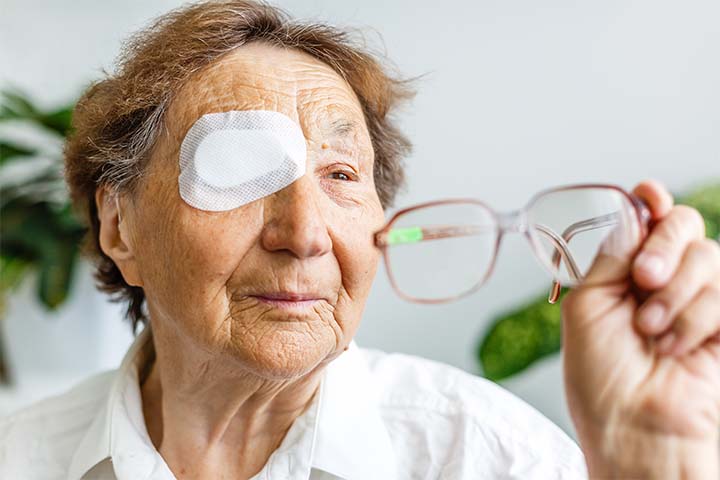
TREAT CATARACTS
In the case of advanced lens opacification, surgery is the only treatment option that can restore good vision. Alternative therapies or medication are not available according to current scientific knowledge.
During the operation, which is usually performed on an outpatient basis, the natural lens of the eye is removed and replaced with an artificial lens (also known as an intraocular lens or IOL for short). The procedure is usually performed under local anesthesia and is painless for you. You can return home on the same day.
LENS REPLACEMENT PROCEDURE
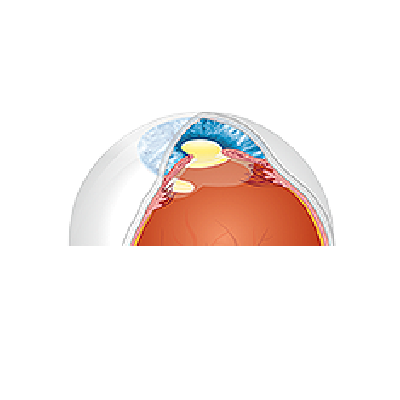
The inside of the eye is accessed through a small incision, which normally closes again without sutures.
First, the natural lens of the eye is crushed and removed.
The artificial lens is soft and can therefore be folded and inserted into the eye using a gentle, minimally invasive procedure.
In the final step, the IOL unfolds and the surgeon aligns it precisely. The IOL is securely fixed in the eye using elastic clamps.
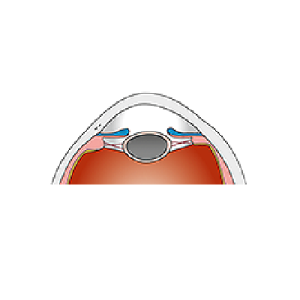
STEP 1
Opening in small section technique
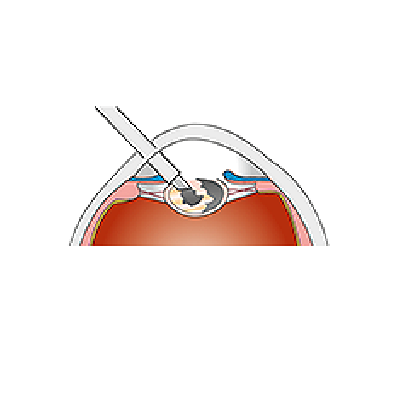
STEP 2
Crushing and removal of the cloudy eye lens
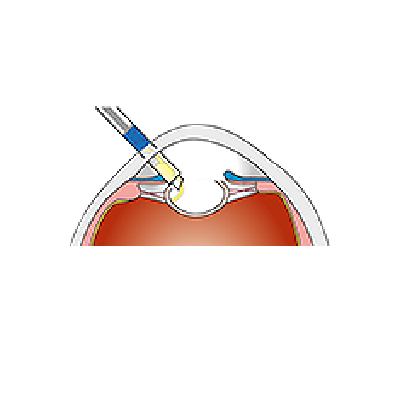
STEP 3
Inserting the folded artificial lens
STEP 4
Precise alignment of the intraocular lens
Normally, clear vision is possible again shortly after the operation.
EXTRA INDIVIDUALLENS SELECTION
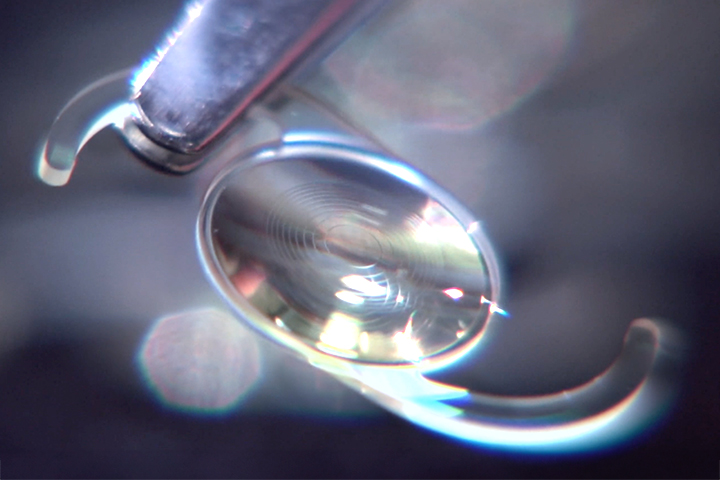
A variety of implants (artificial eye lenses or IOLs) with different properties are available for the treatment of cataracts. So-called monofocal lenses (“single vision lenses”) made of high-quality material are used as standard treatment. They ensure sharp vision at the preferred main distance (far or near).
Innovative premium intraocular lenses are equipped with special functions and can offer additional benefits over standard IOLs depending on personal needs and medical criteria.
At HumanOptics, even basic care includes implants that are manufactured 100% in Germany from high-quality materials and offer aspherical optics for high-contrast vision. Find out more about us, our production sites and quality standards.
Monofocal or single vision IOLs
Provide sharp vision at the preferred main visual distance, mostly for distance vision.
IOLs with magnified XL optics
Particularly advantageous with wide pupils or an increased risk of retinal diseases (e.g. diabetes mellitus, severe short-sightedness, etc.).
Toric optics
For additional correction of an existing astigmatism.
Trifocal IOLs
Offer the possibility of seeing objects sharply over the entire visual range as far as possible without a visual aid: from the distance to the intermediate range and up close, similar to varifocals.
Additional blue light filter selectable
Potentially dangerous, high-energy blue light is filtered, which can prevent possible damage to the retina.
Note
Which intraocular lens is most suitable for you or your relative and best suited to your personal needs will be decided in consultation with the doctor. Don’t be afraid to ask questions and express your wishes and concerns.
- Augenärztliche Akademie Deutschland. https://www.augeninfo.de/offen/pressetext_aad.php?meldung=196. Accessed on 21.11.2025.
- Berufsverband der Augenärztinnen und Augenärzte Deutschlands e.V. https://www.augeninfo.de/offen/index.php?thema=412. Accessed on 21.11.2025.